Elektron resurslar
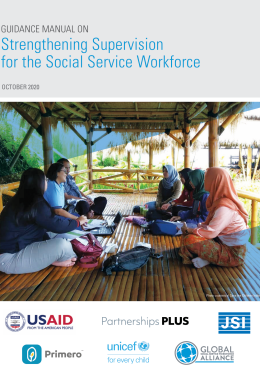
Strengthening Supervision for the Social Service Workforce
This document represents the work of the Global Social Service Workforce Alliance (Alliance) Supervision Interest Group (SIG). As a global network, the Alliance convenes individuals and organizations across stakeholder groups to advance knowledge on the latest trends, share innovative practices to overcome challenges, and devise tools to address gaps affecting the social service workforce.

Global Standards for Social Work Education and Training
The International Association of Schools of Social Work (IASSW) and the International Federation of Social Workers (IFSW) have jointly updated the Global Standards for Social Work Education and Training. The previous version of the Global Standards for Social Work Education and Training document was adopted by the two organisations in Adelaide, Australia in 2004. Between 2004 and 2019, that document served as an aspirational guide setting out the standards for excellence in social work education. With the adoption of a new Global Definition of Social Work in July 2014, and the publication of the updated Global Social Work Statement of Ethical Principles in 2019, the Global Standards for Social Work Education and Training document should be updated to integrate the changes in these two documents and to reflect recent developments in global social work.
Educational Policy and Accreditation Standards
Accreditation is a system for recognizing educational institutions and the professional programs affiliated with those institutions as having a level of performance, integrity, and quality that entitles them to the confidence of the educational community and the public they serve. The Commission on Accreditation (COA) of the Council on Social Work Education (CSWE) is recognized by the Council for Higher Education Accreditation (CHEA) to accredit baccalaureate and master’s degree programs in social work education in the United States and its territories.
Practice Standards for School Social Workers
This revision of the school social work standards could not have been completed without support from several individuals. It is with heart felt appreciation that we thank the Task Force for School Social Work Standards members and cochairs, Michael Cappiello and Gwen R. Bouie-Haynes, for their steadfast and steady leadership in the com pletion of this document. We give our deepest appreciation to Janice Harrison, executive assistant, for her unwavering technical support, and we thank Mirean Coleman, NASW director of clinical practice, for leading us along the pathway to publication.

Applied Psychology for Social Work, EWAN INGLEBY
This book has been written for student social workers needing to study and apply psychology to their own practice. Although psychology is typically studied in the first year of the degree programme as a separate module it is a subject that links to much of the rest of the academic curriculum. It is a subject that makes an especially important contribution to understanding human growth and development. Applying psychological therapies to social work can be a way of raising standards and ensuring good practice. This objective is as relevant today as it ever has been. As Mithran Samuel (2006) observes about social work in general, social care professionals are becoming overwhelmed by paperwork at the expense of working with service-users.

Human Growth and Development An introduction for social workers
It is written so as to capture the interest which you will inevitably find in your work with people. You will become involved in their lives and development, and at times will have a significant responsibility as to the direction this takes. The subject is endlessly fascinating, as much for experienced and expert workers as for the new student. By making this human and professional interest the focus of the text, it has been possible to create a textbook for all students – suitable for readers who have already studied some psychology and sociology and for those who are tackling these academic subjects for the first time.
Understanding and Using Theory in Social Work, JULIETTE OKO
Understanding and using theory in social work is written for student social workers who are beginning to develop their skills and understanding of the requirements for practice. While it is primarily aimed at students in their first year or level of study, it will be useful for subsequent years depending on how your programme is designed, what you are studying and especially as you move into practice learning. The book will also appeal to people considering a career in social work or social care but not yet studying for a social work degree. It will assist students undertaking a range of social and health care courses in further education. Nurses, occupational therapists and other health and social care professionals will be able to gain an insight into the new requirements demanded of social workers.

Principles of Social Psychology
Social psychology is the scientific study of how we feel about, think about, and behave toward the people around us and how our feelings, thoughts, and behaviors are influenced by those people. As this definition suggests, the subject matter of social psychology is very broad and can be found in just about everything that we do every day.
Theories and methods of social work
Social work as a profession, while originating from different traditions, was closely connected with social movements at the beginning of the twentieth century, as is evident from the work of Alice Salomon, Jane Adams, Ilse Artl, Helena Radlinska and others that contributed to its first conceptualisations. Since then, social work has gone through different phases and has acquired local interpretations that, in many cases, reflect differences in the develop ment of welfare regimes.

Scientific Inquiry in Social Work, Matthew DeCarlo
How do social workers know the right thing to do? It’s an important question. Incorrect social work actions may actively harm clients and communities. Timely and effective social work interventions further social justice and promote individual change. To do make the right choices, we must have a basis of knowledge, the skills to understand it, and the commitment to growing that knowledge. The source of social work knowledge is social science and this book is about how to understand and apply it to social work practice.
Social Work and Empowerment, Robert Adams
This book grew partly from personal experiences of the need for self-help to contribute to the care of my own relatives and partly from my efforts to support the self-help initiatives of MIND, as the then chairperson of MIND’s advisory committee in Yorkshire and Humberside. To that chance initiation into the politics of empowerment in mental health I owe a debt to Norman Jepson and the late John Crowley. Through involvement in Mind Your Self in Leeds, my collaboration with Gael Lindenfield, who founded it, led to several books and other publications. The book also began partly with the awareness that despite the growing numbers of handbooks on selfhelp, there was a need for an accessible yet critical text, which would provide a framework for the development of more effective relationships between professionals and self-helpers.

Direct Social Work Practice, Dean H. Hepworth and Ronald H. Rooney
We would like to thank the following colleagues for their help in providing useful comments and suggestions. We have been supported by members of our writers’ groups, including Mike Chovanec, Annete Gerten, Elena Izaksonas, Rachel Roiblatt, and Nancy Rodenborg. We also want to thank research assistants David DeVito and Tonya VanDeinse for their research, reviews, construction of cases, and management of the bibliography. We owe a special debt of gratitude to our video and simulation participants: Sarah Gottfried, Shannon Van Osdel, Emily Williams, Heather Parnell, Kristen Lukasiewicz, Erika Johnson, Angela Brandt, Irwin Thompson, Ali Vogel, Mrs. Janic Mays, Dorothy Flaherty, Val Velazquez, Kathy Ringham, Mary Pattridge, and Cali Carpenter.