Electronic resources
Comprehensive handbook of social work and social welfare, Barbara W.White
The profession of social work spans more than 100 years. Over this period, the profession has changed in scope and depth. Despite the varied functions and methods of our profession, it has always been committed to social justice and the promotion of well-being for all. The profession has made great strides and is experiencing a resurgence of energy, commitment, and advancement as we face new global realities and challenges and embrace new and innovative technologies.
Human Rights in Child Protection, Asgeir Falch-Eriksen and Elisabeth Backe-Hansen
Next year will mark the thirtieth anniversary of the UN Convention on the Rights of the Child. The convention is a catalogue of rights that, among other things, is meant to safeguard children from maltreatment. Children living in nation-states claiming to abide by the convention should also be able to make a claim based on their right to protection. The child’s right to protection, specified in Art. 19 of the convention, is intended to establish child protection services that ensure that children develop and experience their childhoods in safe family environments.
Ageing, Diversity and Equality: Social Justice Perspectives, Sue Westwood
I wish to express my sincere gratitude to each of the contributors, who have so patiently stuck with me through what has turned out to be quite a complex process. The high standard of their authorship is something I appreciate and value, and is what has made the book something we can all be proud of. Rosie Harding and Ruth Fletcher may find it odd to be named, yet again, in my acknowledgements, but their ‘growing’ of me sticks with me, and I am constantly drawing upon all they taught me.
Aging Well, Jean Galiana and William A.Haseltine
We thank all those who contributed their time and thought to help us understand the issues facing older adults and what can be done to ensure that all have access to high-quality affordable care and the opportunity to live productive and active lives. Claude Thau patiently described the rocky history of the long-term care insurance industry and why many still do not have long-term care insurance today.
Practice Standards for Clinical Social Workers
NASW would like to thank the Clinical Social Work Association for the participation of Laura Groshong, LICSW, director of policy and practice, in the revision of the NASW Practice Standards for Clinical Social Workers.
Collaborating Against Child Abuse
Twenty years ago, I boarded an airplane for Huntsville, Alabama. Over the course of the long journey to this fnal destination, I could not help but wonder if embarking on the trip had been a smart decision. From a European perspective, the USA had never been a role model for child welfare, and in that context, the southern states were probably regarded least desirable of all.
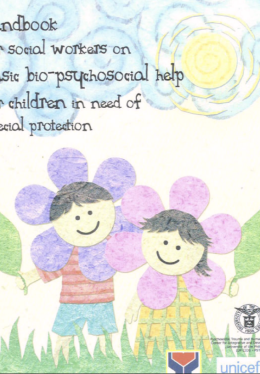
Handbook for Social Workers on Basic Bio-Psychosocial Help for Children in Need of Special Protection
This handbook is a must have for all social workers and child caregivers in the Philippines. Offhand, we can come up with at least three major reasons why. One is that it provides practical guides, based on sound theoretical foundations and firm underlying principles, on how to promote psychosocial well-being among children in need of special protection (CNSP). The guides and activities build on children’s own natural resilience and their natural network of support with their families and communities.
Mental Health Atlas
The Mental Health Atlas is a project of the World Health Organization (WHO). The overall vision and conceptualization of the project is provided by Dévora Kestel. The Mental Health Atlas 2020 is the latest in a series of publications that first appeared in 2001, with subsequent updates published in 2005, 2011, 2014 and 2017. This edition of the Mental Health Atlas is supervised and coordinated by Tarun Dua and Fahmy Hanna.
Global Status Report on Violence Prevention
The Global status report on violence prevention 2014 benefitted from the contributions of many World Health Organization (WHO) staff and partners from other organizations. Alexander Butchart and Christopher Mikton coordinated and wrote the report. Etienne Krug provided strategic direction. Data management and statistical analysis were conducted by Christopher Mikton and Daniel Hogan, assisted by Kacem Iaych and Charles Upton.
Responding to child maltreatment: a clinical handbook for health professionals
We gratefully acknowledge the advice and review of the text by Jennifer Hegle, Nickolas Agathis, and Greta Massetti from the US Centers for Disease Control and Prevention (CDC), Harriet MacMillan, Jill McTavish and Christine Kee from McMaster University, the contribution to the sections on mental health from Chiara Servili, Aiysha Malik, and Mark van Ommeren of the WHO Department of Mental Health and Substance Abuse (MSD), the contribution to the sections on sexually transmitted infections from Teodora Wi and Olufunmilayo Lesi of the WHO Department of HIV, Hepatitis and STIs (HHS)
Child Abuse and Neglect Prevention Resource for Action
We would like to thank several individuals who contributed greatly to the development of this resource. First, we give special thanks to Dr. Linda Dahlberg for her vision, guidance, and support throughout the development of this resource. We thank Division, Center, and CDC leadership, and members of the CDC Division of Violence Prevention Child Maltreatment Workgroup for their careful review and helpful feedback on earlier iterations of this document. We thank Alida Knuth for her formatting and design expertise. We also extend our thanks and gratitude to all of the external reviewers for their helpful feedback, support and encouragement for this document.
Child Maltreatment Surveillance
We thank the experts and panel members who took time from their busy schedules to review and provide feedback on numerous drafts of this publication. Their valuable input helped guide us through the lengthy development process. We also thank the staff members of CDC’s National Center for Injury Prevention and Control for their contributions, especially