Winners of the “Youth Research for the Well-being of Society” contest have been announced
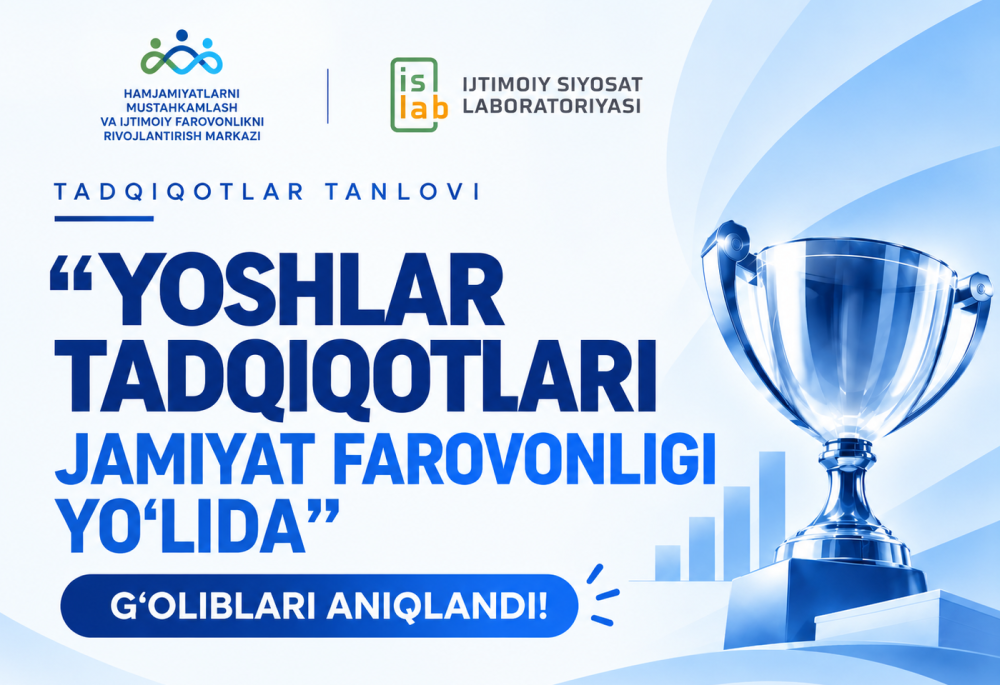
“Youth Research for Community Well-Being” Competition Concludes
The “Youth Research for Community Well-Being” competition, organized by the Centre for Advancing Community Strengths and Social Wellbeing in partnership with the Social Policy Lab, has concluded.
Throughout the competition, young researchers aged 16–18 conducted studies in the areas of digital support, social well-being, inclusion, financial literacy, and safe environments. Participants analyzed relevant social challenges and presented their findings, practical recommendations, and proposed solutions to a panel of judges.
Following the evaluation of the research projects and presentations, the winners were announced:
1st Place — Marifatkhon Umarova
“From Silence to Safe Reporting: Designing a Trust-Centred Digital Support Pathway for Adolescents in Uzbekistan”
2nd Place — Khadicha Sidikova
“Cancel Culture on Social Media: How Fear of Online Judgement Affects Adolescents’ Freedom of Expression”
3rd Place — Sevara Abdimuminova
“Help-Seeking Behaviour Among Adolescents in Situations of Bullying and Violence”
3rd Place — Gulixon Roʻzimboyeva
“The Trilend Phenomenon”
The competition provided an important platform for young people to explore pressing social issues affecting their peers through research, draw evidence-based conclusions, and propose practical solutions aimed at improving young people’s well-being, safety, and social participation.
We congratulate the winners and wish all young researchers every success in their future academic and research endeavors!
Research Abstracts
Marifatkhon Umarova
“From Silence to Safe Reporting: Designing a Trust-Centred Digital Support Pathway for Adolescents in Uzbekistan”
The study focuses on violence against children in Uzbekistan and examines the opportunities available for children to independently seek help in situations of violence. According to the data presented by the author, nearly two-thirds of children aged 1–14 experience forms of violent discipline. At the same time, of the 1,064 complaints submitted to the Children’s Ombudsperson in 2024, only 44 were filed by children themselves.
Using a multiple case study approach, the research examines digital and AI-based tools designed to address violence against children in Central Asia, Europe, and the United States. These tools are assessed against four key criteria: anonymity, freedom from surveillance, credibility, and effective referral to appropriate support services.
Based on the findings, the study identifies the core functions required for a safe reporting channel for children and adolescents and proposes a phased model for testing and developing a trust-centred digital support pathway.
Khadicha Sidikova
“Cancel Culture on Social Media: How Fear of Online Judgement Affects Adolescents’ Freedom of Expression”
The study explores how fear of public criticism and online judgement affects young people’s willingness to express their opinions freely on social media. An anonymous online survey was conducted among 29 participants, most of whom were aged 17–19.
The findings show that 82.8% of respondents had witnessed cases of mass public criticism on social media, while 69% reported that they were often or sometimes afraid to express their opinions due to fear of criticism.
The results suggest that fear of condemnation may encourage self-censorship among young people. The author does not view cancel culture as entirely negative; rather, the study highlights the risks that arise when criticism develops into mass pressure and limits opportunities for constructive dialogue. As a practical response, the author proposes a school-based initiative called “SPEAK SAFE.”
Sevara Abdimuminova
“Help-Seeking Behaviour Among Adolescents in Situations of Bullying and Violence”
The study examines help-seeking behaviour among adolescents aged 14–18 in situations involving bullying and violence. A total of 61 adolescents participated in an anonymous online survey.
The findings indicate that the most frequently reported forms of violence were verbal violence — 67.2% and psychological violence — 55.7%.
Among adolescents who had experienced or witnessed violence, 52.9% reported that they would not tell anyone about the situation. By comparison, only 8.1% of respondents without such experience indicated that they would remain silent.
Based on the findings, the study proposes practical recommendations for introducing anonymous reporting channels in schools and developing peer-support systems to make it easier and safer for adolescents to seek help.
Gulixon Roʻzimboyeva
“The Trilend Phenomenon: Financial Literacy, Social Illusion and a Safe Environment”
The project brings together three interconnected areas affecting young people’s lives: financial literacy, social illusions, and safe environments.
The study highlights the risks associated with young people beginning to manage money independently without sufficient financial knowledge. Online gambling, unlicensed microcredit, and “buy now, pay later” schemes may expose young people to the risk of debt. At the same time, the image of a “luxurious lifestyle” promoted on social media is examined as a factor that may encourage spending beyond one’s financial means.
The author proposes introducing regular financial literacy education at different stages of the education system, supported through a national digital platform. The project also addresses issues related to inclusive education and creating safer public spaces.